Commercial Roofing
Choosing a Commercial Roof in Atlanta: TPO vs. Modified Bitumen vs. Liquid-Applied
By Robert Shelby · July 19, 2026 · 14 min read
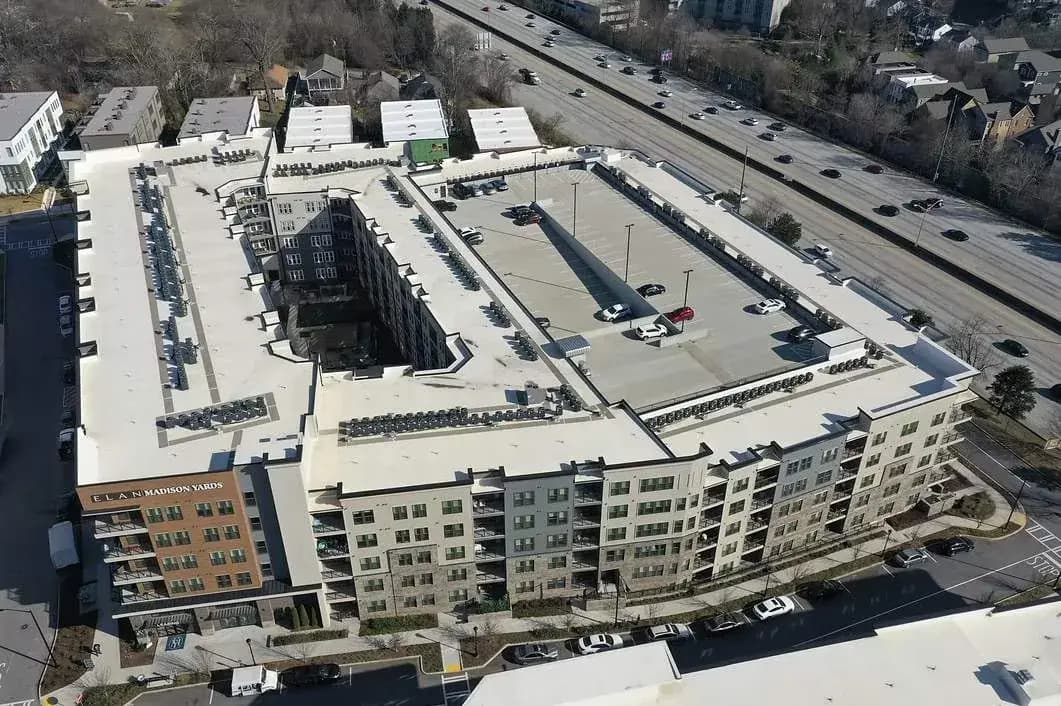
Most of the commercial roofs we work on in the Atlanta metro have one thing in common that a homeowner never has to think about: they are flat, or close to it. That single fact changes everything about how the roof is built, how it fails, and how you should spend your money on it. I have spent my career on roofs, and the commercial owners and property managers who get the best return are the ones who understand their handful of real options before a salesperson starts talking. So that is what this guide is: the three flat-roof systems we install the most, what each honestly costs, how long each lasts in Georgia heat, and how to tell which one your building actually needs.
There is no single best commercial roof. There is a best roof for your building, your budget, and how long you plan to hold the property. Pick wrong and you either overpay for a system you did not need or you save a few dollars now and buy another roof years too early. Here is how to pick right.
A Flat Roof Fails Differently, So It Is Built Differently
A steep residential roof sheds water by gravity. Rain hits a shingle, runs down to the next one, and it is gone. A low-slope commercial roof cannot rely on that. Water sits, ponds, and looks for any seam or penetration to work into, sometimes for hours after a storm. That is why a commercial roof is not shingles at all. It is a continuous waterproof membrane, sealed at every seam and around every pipe, drain, curb, and HVAC unit on the roof.
Because the whole roof is a sealed skin rather than overlapping pieces, the questions that matter are different too. How are the seams joined? How does the surface hold up to standing water and Georgia UV? Can it take the foot traffic of technicians servicing the equipment up there? The three systems below answer those questions in different ways and at different price points.
The Three Systems We Install Most
Here is how the three stack up on the two numbers owners ask about first: what it costs to install per square foot, and how many years you get before you are planning the next one.
TPO: The White Single-Ply Workhorse
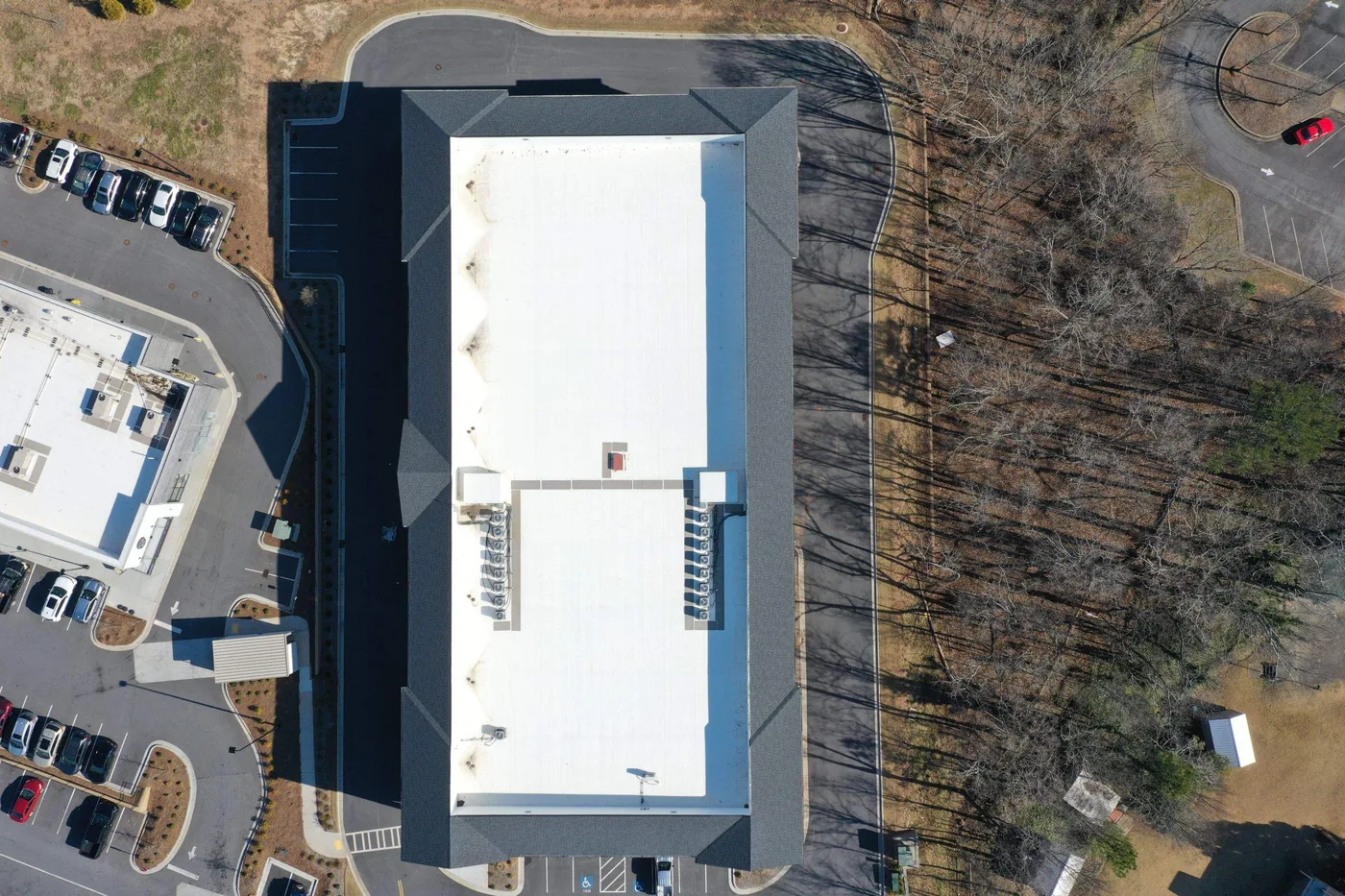
TPO is a single-ply membrane, usually bright white, rolled out across the roof and heat-welded seam to seam so the joints are effectively fused into one continuous sheet. It is what you see on most of the newer commercial roofs across the metro, and it is what we installed on the multifamily complex in the photo at the top of this article.
Two things make TPO the default choice for new buildings and full tear-offs. First, that white surface reflects sunlight instead of soaking it up, which in a Georgia summer measurably lowers the cooling load on the building below. Second, heat-welded seams do not depend on adhesive or tape that ages out; the seam is as strong as the membrane itself. You get 20 to 30 years out of a well-installed TPO roof, and the payback shows up on the power bill the whole time.
Modified Bitumen: Tough, Proven, and Easy on the Budget
Modified bitumen is the modern descendant of the old built-up tar-and-gravel roof. It is asphalt reinforced with polymers and installed in layers, usually two, so you have real redundancy built into the membrane. The surface is typically a dark granulated cap sheet, and it is genuinely tough. If your roof sees a lot of foot traffic because technicians are up there servicing equipment, modified bitumen shrugs it off in a way a thinner membrane does not.
It sits a notch below TPO on both price and lifespan, and that is exactly why it stays popular. For a re-roof over a sound deck where the owner wants a proven, no-drama system without paying the top of the market, it is often the smart call. Expect 15 to 20 years of service.
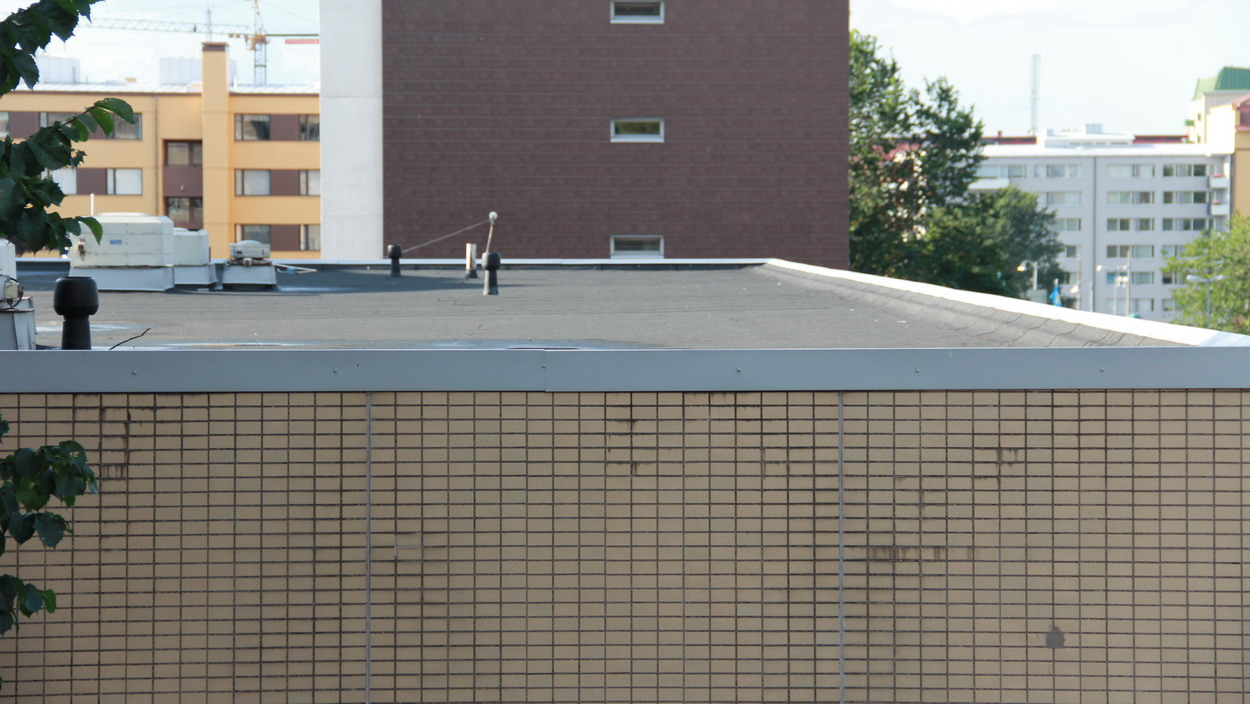
Photo: Htm, via Wikimedia Commons (CC BY-SA 3.0). Shown to illustrate a modified-bitumen membrane surface.
Liquid-Applied Restoration: Buying Years Without a Tear-Off
The third option is not a new roof at all in the usual sense. A liquid-applied system, often silicone or acrylic, is a coating rolled or sprayed over an existing roof that still has structural life in it. It goes on as a liquid and cures into a seamless waterproof skin with no seams to fail, because there are no seams. This is the system our MasterCraftsman Liquid-Applied certification is built around, and it is one of the most misunderstood tools we carry.
Used at the right moment, on a roof that is watertight but aging, a restoration coating adds 10 to 20 years and can be renewed with a fresh topcoat down the road instead of torn off. It is the least expensive of the three up front, and because there is no tear-off, the building keeps running and tenants barely notice the work. The catch is that it is not a rescue for a roof that is already failing. If water is getting in and the deck is wet, a coating just traps the problem. The honest answer there is a tear-off, and we will tell you so.
Not Every Commercial Roof Is Flat
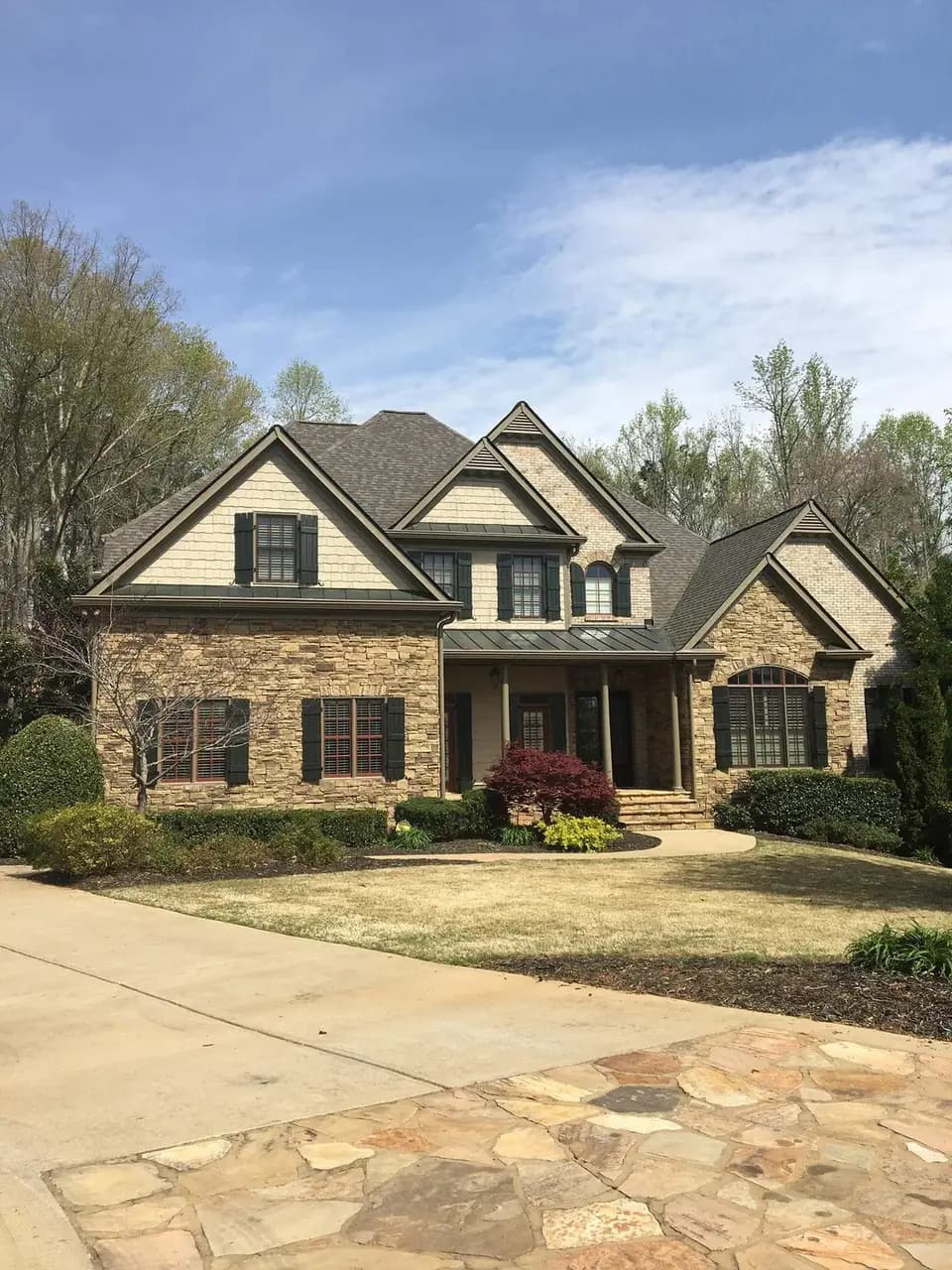
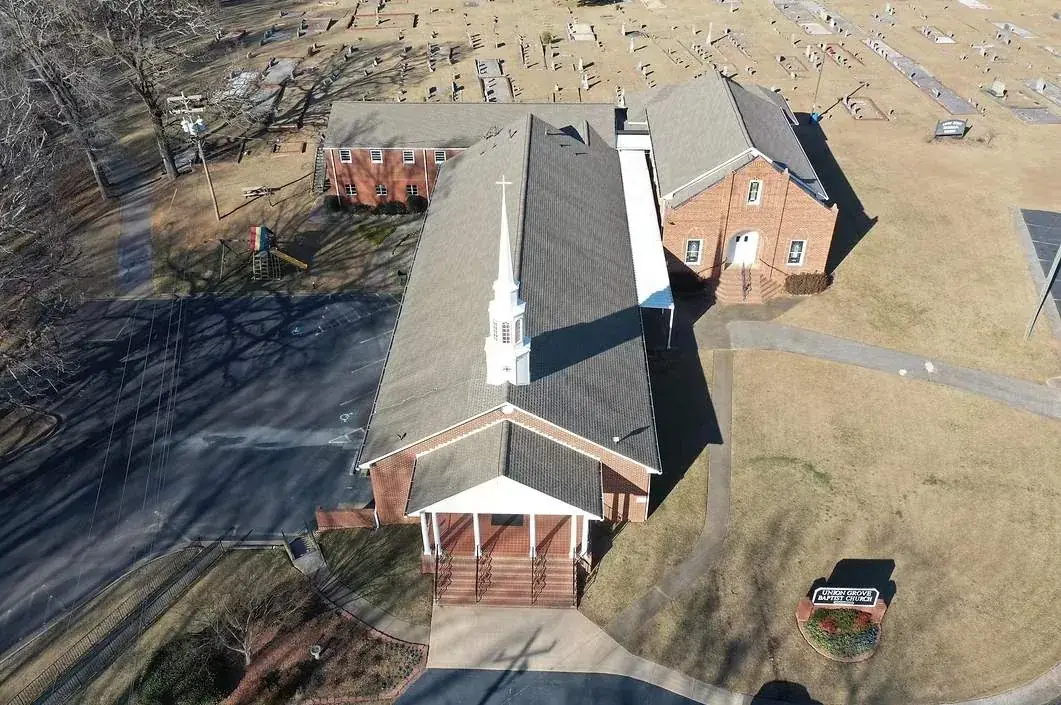
Plenty of commercial and institutional buildings in North Georgia have steep-slope roofs: churches, schools, offices with architectural rooflines, older brick buildings. Those get shingles or metal, not a membrane, and the same rules from the residential world apply, scaled up. The church below is one of ours, and it needed the same careful attention to valleys, flashing, and ventilation that any steep roof does, just across a much bigger footprint.
The point is simple: the roof system has to match the building. A flashy membrane spec means nothing if it is the wrong system for your roof, and the first job of a good commercial roofer is to figure out which category you are actually in before quoting anything.
Match the System to the Building
Here is the quick version of how we steer owners toward one of the three, based on the situation the building is in right now.
The Real Budget Killer Is the Leak You Ignore
Here is the thing that costs commercial owners the most money, and it is not the membrane you pick. It is deferred maintenance. On a flat roof, the failure points are almost never the wide-open field of the membrane. They are the details: the seams, the drains, the edge metal, and above all the dozens of penetrations where pipes, curbs, and HVAC units punch through the roof.
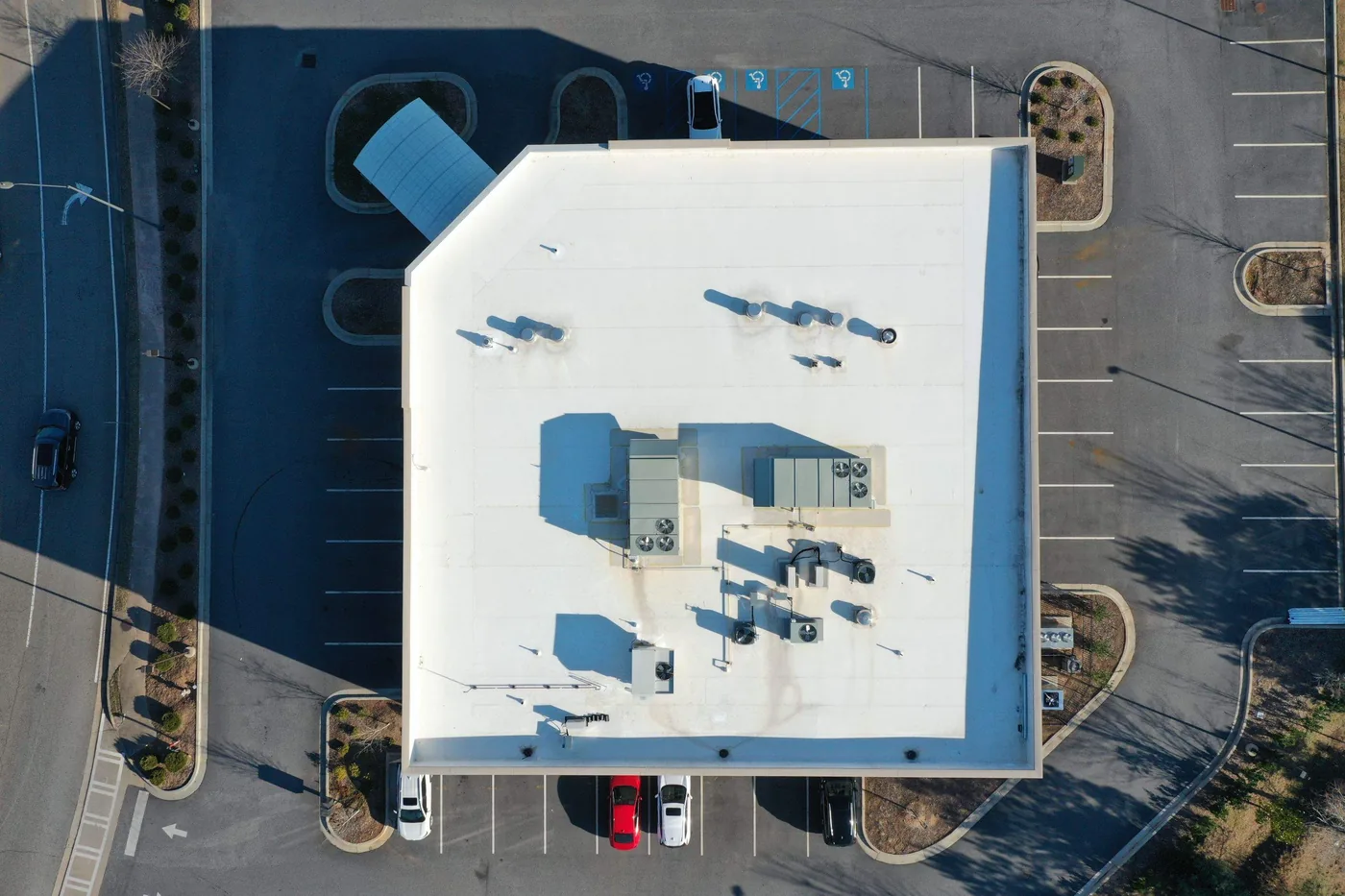
Look at the office building below. Every one of those rooftop units, every pipe and curb, is a spot where the membrane had to be cut and sealed by hand. Each one is a small maintenance item today and a five-figure interior repair if it is left to leak for a year. A commercial roof rewards attention. A twice-a-year inspection and a small budget for resealing details will stretch any of these three systems to the top of its range and often beyond. Skipping it is how a 25-year roof turns into a 15-year roof.
This is also why the recoat-versus-replace decision matters so much on the money side. A liquid-applied restoration on a roof that is still sound is one of the best values in the business, because you are extending an asset instead of throwing it away. But it only works if you catch the roof before the leaks start. Wait too long and you lose the coating option entirely and pay for a full tear-off instead. The single most expensive thing you can do to a commercial roof is ignore it.
Why Owners in the Metro Call Us
Platinum Roofing has been on Georgia roofs since 2000. We are licensed and insured, we hold the MasterCraftsman Liquid-Applied certification for restoration coatings, and we work on everything from single retail buildings to full multifamily complexes across the Atlanta metro. Just as important, we quote the roof your building actually needs. If a coating will honestly buy you a decade, we will tell you that instead of selling you a tear-off. If the deck is wet and a coating would only hide the problem, we will tell you that too.
If you own or manage a commercial property with a flat roof and you are not sure where it stands, that is exactly the call to make before the next hard summer storm. We give free, no-pressure inspections across our service areas, and we will walk the roof, check every seam and penetration, and give you a straight answer and an itemized estimate. Call us at (770) 419-5714 or contact us to set it up. You can read more about our commercial roofing work, our approach to every roof repair we take on, and the team about Platinum Roofing. If your roof is leaking right now, our emergency roofing crew can protect the inside of the building while we plan the permanent fix.
Frequently Asked Questions
How much does a commercial flat roof cost per square foot in Georgia?
For the three systems we install most, plan on roughly $5.50 to $9.50 per square foot installed for TPO single-ply, $4.50 to $8.00 for two-ply modified bitumen, and $3.50 to $7.00 for a liquid-applied restoration coating over a sound existing roof. Those are metro Atlanta ranges, and the real number for your building depends on the size of the roof, the condition of the deck underneath, how hard the roof is to access, and how much rooftop equipment has to be worked around. The only way to get a firm figure is an inspection, which we do for free.
Is TPO or modified bitumen better for my building?
Neither is better in a vacuum. TPO is usually the stronger choice for a new building or a full tear-off, because the reflective white surface lowers cooling costs and the heat-welded seams give you 20 to 30 years. Modified bitumen is often the smarter call for a re-roof over a sound deck when you want a proven, tough membrane at a lower up-front cost, or when the roof sees heavy foot traffic. The right answer comes from looking at your specific roof, your budget, and how long you plan to hold the property.
What is a liquid-applied roof coating and when does it make sense?
A liquid-applied coating, typically silicone or acrylic, is a waterproof layer rolled or sprayed over an existing roof that still has structural life in it. It cures into a seamless skin with no seams to fail, adds 10 to 20 years, and can be renewed later with a fresh topcoat instead of a tear-off. It makes sense when a roof is watertight but aging and you want to extend it at the lowest cost with minimal disruption to tenants. It does not make sense on a roof that is already leaking with a wet deck, because a coating there just traps the moisture. Timing is everything with restoration.
How often should a commercial flat roof be inspected?
Twice a year is the standard we recommend, ideally in spring before storm season and in fall, plus a look after any major storm. Flat roofs fail at the details, the seams, drains, edge metal, and the penetrations around pipes and HVAC units, and those are exactly the spots a routine inspection catches while the fix is still small and cheap. A modest maintenance budget is the single best thing you can do to push any commercial roof to the top of its service life and avoid a far more expensive interior repair.
Do you work on steep-slope commercial buildings too?
Yes. Not every commercial roof is flat. Churches, schools, and older brick buildings often have steep-slope roofs that take shingles or metal rather than a membrane, and we handle those across North Georgia as well. The system has to match the building, so the first step is always figuring out which type of roof you actually have before we recommend anything.

About the Author
Robert Shelby
Fourth-generation roofer who founded Platinum Roofing in 2000. Meet the Platinum Roofing team →