Roof Repair
Why Is My Roof Leaking? The 6 Most Common Sources and How We Find Them
By Robert Shelby · September 30, 2026 · 16 min read
Most leak calls we get start the same way. "There's a brown spot on the ceiling in the upstairs hallway, and I went up in the attic and I can't find anything." That is completely normal, and it is not a sign you missed something obvious. Water almost never comes through the ceiling directly under the spot where it got through the roof. It gets in at one place, runs along the wood for a few feet, and drips wherever the path finally sends it down.
I'm Robert Shelby, a fourth-generation roofer and General Manager at Platinum Roofing in Canton. Our crews have been tracking down leaks across Cherokee, Cobb, and North Fulton counties since 2000, and the good news is that nearly every leak comes from one of a short list of places. Once you know that list, and know how water moves once it is inside, a leak stops being a mystery and becomes a repair with a clear price. Here is what we look for, what you should do today, and why the timing matters so much.
Why the Stain Is Almost Never Under the Leak
A roof is built in layers. On top are the shingles. Under them is a layer of underlayment, and under that is the wood decking, usually plywood or OSB nailed to the rafters. When water gets past the shingles, it does not fall straight down. It hits the underside of the decking or the side of a rafter and follows it downhill, the same way rain runs down a windshield. It keeps going until it reaches a nail, a seam in the wood, or a low spot, and that is where it drops onto the insulation and soaks through to your ceiling.
On a typical North Georgia home, that run is often four to twelve feet. We regularly trace a stain in a hallway or closet back to a pipe boot that sits over a bedroom, or a stain along an exterior wall back to flashing at a dormer on the other side of the attic.
This is also why a patch over the spot that "looks wet" from the attic so often fails. If the patch is not at the entry point, the water just keeps coming in where it always did. Finding the real source is most of the job.
The Six Places Roofs Leak Most Often
These six account for the large majority of the non-storm leaks we repair in North Georgia. If your roof is younger than 15 years and you have a leak, odds are very good it is one of these, and odds are also good that the fix is a targeted repair rather than a new roof.
1. Pipe Boots
Every plumbing vent that comes through your roof is sealed with a pipe boot: a metal or plastic flange with a rubber collar that hugs the pipe. The shingles last 25 years or more, but that rubber collar sits in full Georgia sun all day. It often starts to crack around year ten, and once it splits, rain runs straight down the outside of the pipe into the attic.
Pipe boots are the single most common leak we find, and they are one of the cheapest to fix. Replacing a failed boot usually runs $150 to $400. The catch is that you can rarely see a cracked collar from the yard, which is why this leak tends to go unnoticed until a stain appears.
2. Step and Wall Flashing
Anywhere a roof meets a vertical wall (a dormer, a second-story wall over a porch, a garage that ties into the house), the joint is protected by metal flashing woven in with the shingles. When that flashing was installed short, never installed at all, or sealed with caulk instead of properly layered, water gets behind the siding and down the inside of the wall. These leaks often show up as a stain along the top of a wall or around a window below the roofline. Chimneys are the most common version of this problem, and we cover them in detail in our guide to why roofs leak around the chimney.
3. Valleys
A valley is the channel where two roof slopes meet, and it carries more water than any other part of the roof. In a heavy North Georgia thunderstorm, a single valley can move a lot of water in a hurry. If the valley was not lined with ice and water shield underneath, if the shingles were cut badly, or if pine needles and leaves pile up and dam the water, it can back up under the shingles. Fall is prime time for this, since debris collects in valleys right as the leaves come down.
4. Exposed Nails and Nail Pops
Nails that were driven crooked, placed too high, or left exposed at the ridge and along the edges eventually let water in. On older roofs, the wood decking swells and shrinks with our humid summers and cooler winters, and that movement can push nails up through the shingle above them. Each one is a tiny hole, but a tiny hole directly above your attic is all a slow drip needs.
5. Skylights
Skylights leak in two ways. The first is the flashing kit around the frame, which fails for the same reasons wall flashing does. The second is the skylight itself: the seal between the glass and the frame gives out with age. From inside, both look the same, which is why a skylight leak is worth having someone check on the roof rather than recaulking from below. Often the flashing can be replaced without replacing the whole unit.
6. Roof Vents and Exhaust Fans
Box vents, ridge vents, turbine vents, and the exhaust caps for bathroom fans and dryers all cut a hole in the roof. Their flashing can loosen, their fasteners can back out, and a ridge vent that was installed wrong can let wind-driven rain blow straight in during a storm. If your leak only shows up in hard, sideways rain and not in a gentle all-day soaker, a vent is a strong suspect.
One More: It Might Not Be the Roof
Not every drip from the ceiling is a roof leak, and a good roofer will tell you so. In Georgia, a clogged or disconnected AC condensate line in the attic is a common one, especially in late summer when the system runs nonstop. A bathroom exhaust fan that vents into the attic instead of outside can drip condensation in cold weather. A leaking plumbing line can mimic a roof leak too. We check for all of these on a leak call, because there is no reason for you to pay for a roof repair that will not fix the problem.
What to Do Today If Water Is Coming In
Finding water in the house is stressful, but a few calm steps protect your home and make the repair simpler.
- Catch the water. Put a bucket or trash can under the drip and a towel under that. Move furniture, rugs, and electronics out of the way.
- Relieve a bulging ceiling. If the drywall is sagging with a bubble of water, it can give way all at once. Put a bucket underneath and poke a small hole at the lowest point with a screwdriver so it drains in a controlled way. If the wet spot is near a light fixture, turn that circuit off at the breaker first.
- Take photos. Photograph the stain, the ceiling, anything damaged, and the date. It helps us, and it helps you if the leak turns out to involve an insurance claim.
- Stay off the roof. Wet shingles are slick, and most leaks are impossible to find from on top during rain anyway. Let a crew with the right equipment handle it.
- Call us. If water is actively coming in, our emergency roofing line is answered 24/7 and we can tarp the area to stop the water until the permanent repair. If it is a slow stain that only shows up in heavy rain, book a regular visit and we will find the source.
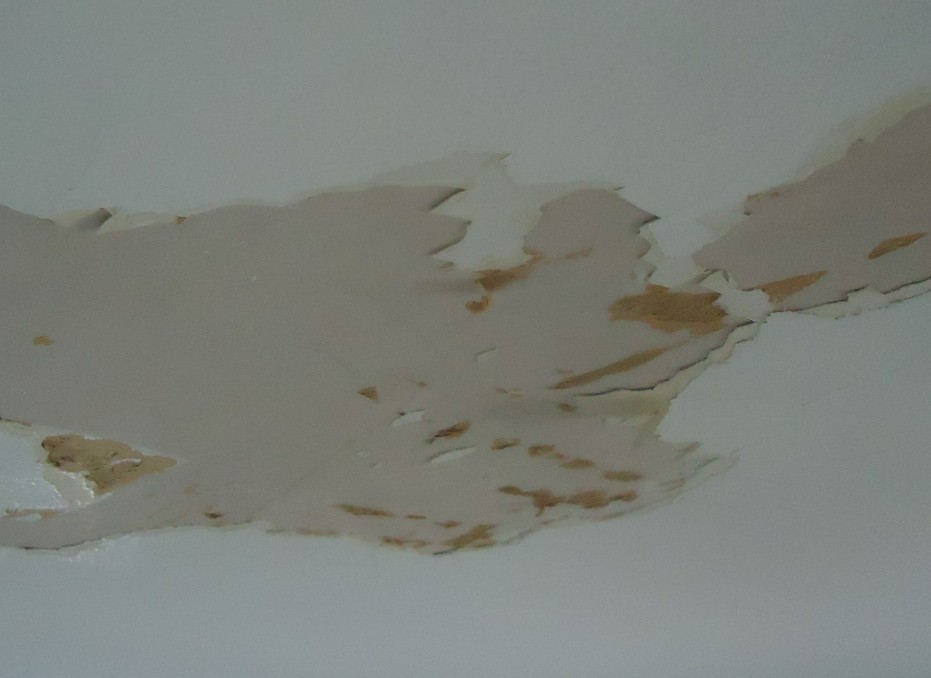
Photo: Tomwsulcer, via Wikimedia Commons (CC0). Shown to illustrate what a slow roof leak does to a drywall ceiling when it is left for a season or two.
Why a Leak Costs More Every Month You Wait
Here is the part I want every homeowner to hear. A roof leak almost never stays the same size. The source problem itself might not change much, but everything the water touches downstream keeps getting worse. Wet insulation flattens and stops insulating. Decking that stays damp through a Georgia summer starts to soften and rot. The drywall stains, then sags. In our humidity, mold can start in a wet attic within a day or two of steady moisture.
The chart below shows what that looks like in dollars. These are typical ranges we see on North Georgia homes, not a quote for your house, but the pattern is the same on every job.
Look at the first row. A cracked pipe boot or a lifted piece of flashing is a small, quick repair. By the last row, the roof repair itself is still about the same price, but now it comes with new decking, new insulation, new drywall, paint, and possibly a mold remediation company. Decking alone runs about $70 to $100 per sheet to replace, and a leak that has been running for a year rarely stops at one sheet.
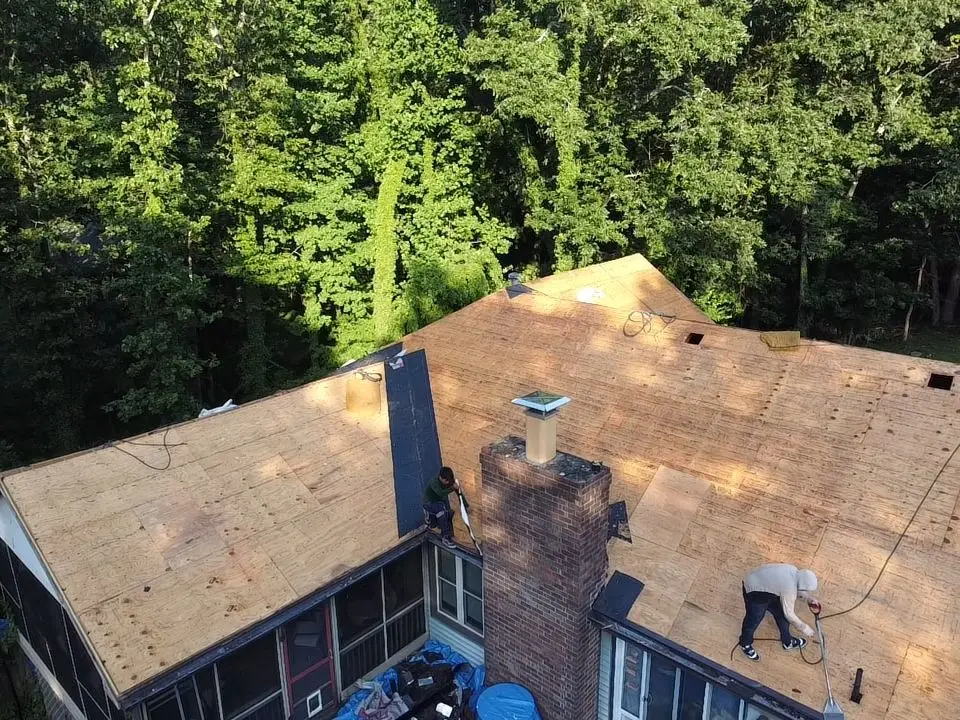
Rotted decking is the line where a small repair turns into real carpentry. We will never shingle over soft or delaminated wood, because new shingles nailed into rotten decking will not hold. When we find it, we cut it out and replace it, and that is the step waiting a season tends to add.
How We Track Down a Leak
When you call us about a leak, here is what the visit looks like.
We start inside. We look at the stain, then go into the attic with a light and follow the water trail uphill: darkened wood, rusty nail tips, flattened insulation, drip marks. That trail usually points straight at the entry point.
Then we go on the roof. We check the suspected spot and everything around it: pipe boots, flashing, valleys, vents, nails, and the condition of the shingles in general. If the source is not obvious, we can water-test sections of the roof one at a time, starting low and working up, until someone in the attic sees it come through.
You get photos and a straight answer. We show you what we found, explain what is causing it, and give you the repair price before any work starts. If it is a $200 pipe boot, that is what we tell you. If the leak is a symptom of a roof that is simply worn out, we tell you that too, and we show you why.
Our roof repair crews carry the common parts on the truck, so many leak repairs are handled the same visit. And if the roof has had several repairs already, our guide to roof repair vs. roof replacement walks through how to tell when patching stops making sense.
Get the Leak Found and Fixed While It Is Small
A roof leak is one of the most fixable problems a house can have, as long as it is caught early and fixed at the source. Our team has been doing exactly this for North Georgia families since 2000, and we would be glad to take a look at yours.
If you have a stain, a drip, or a spot that only shows up in hard rain, call us at (770) 419-5714 or book a free roof inspection online. If water is coming in right now, call the same number any time, day or night, and we will get the area protected. We serve Canton, Woodstock, Roswell, Alpharetta, Marietta, Kennesaw, and the rest of our North Georgia service area.
Frequently Asked Questions
Why is my roof only leaking when it rains hard?
A leak that only appears in heavy or wind-driven rain usually points to flashing, a vent, or a valley. In a gentle rain, water runs off the shingles normally. In a hard storm, wind pushes water sideways and upward under flashing and vent caps, and valleys fill faster than they can drain. Those are the spots we check first when a homeowner tells us the leak only shows up in big storms.
How do I find where my roof is leaking?
Start in the attic with a flashlight, on a dry day or during rain if it is safe. Look for dark or damp wood, rusty nail tips, water trails, and matted insulation, then follow them uphill, since water runs down the decking before it drips. The actual entry point is usually above and uphill from the ceiling stain, often by several feet. If you cannot find it, a roofer can trace it from inside and out, and we include that in our free inspection.
How much does it cost to fix a roof leak in North Georgia?
Most leak repairs in our area run between $300 and $1,500. A single pipe boot is often $150 to $400. Flashing repairs, valley work, and skylight flashing are on the higher end. The price climbs when water has been running long enough to rot the decking or damage the ceiling, which is why fixing a leak early saves so much.
Is a roof leak an emergency?
If water is actively coming into the living space, pooling on the floor, or the ceiling is sagging, treat it as an emergency: catch the water, protect your belongings, and call a roofer who can tarp the area. Platinum Roofing answers emergency calls 24/7 at (770) 419-5714. A small stain that only appears after heavy rain is not an emergency, but it should be looked at within a few weeks before it spreads.
Does homeowners insurance cover a roof leak?
It depends on the cause. Leaks from sudden damage, like a storm or a fallen tree, are often covered. Leaks from age, wear, or a slow failure like a cracked pipe boot usually are not, and the insurer may also decline interior damage that built up over a long period. Our insurance claims guide walks through how Georgia claims work and what adjusters look for.
Can I fix a roof leak myself?
Some homeowners can safely swap a pipe boot on a low, walkable roof, but most leak repairs involve working flashing into the shingles correctly, which is hard to do well without experience. A tube of roofing caulk over the problem usually buys a few months at best and can make the real repair harder later. For your safety and for a fix that lasts, it is worth having a professional do it.

About the Author
Robert Shelby
Fourth-generation roofer who founded Platinum Roofing in 2000. Meet the Platinum Roofing team →