Storm Damage
Trees Over Your Roof: Overhanging Limbs, and What to Do If One Falls
By David Blackwell · November 10, 2026 · 16 min read
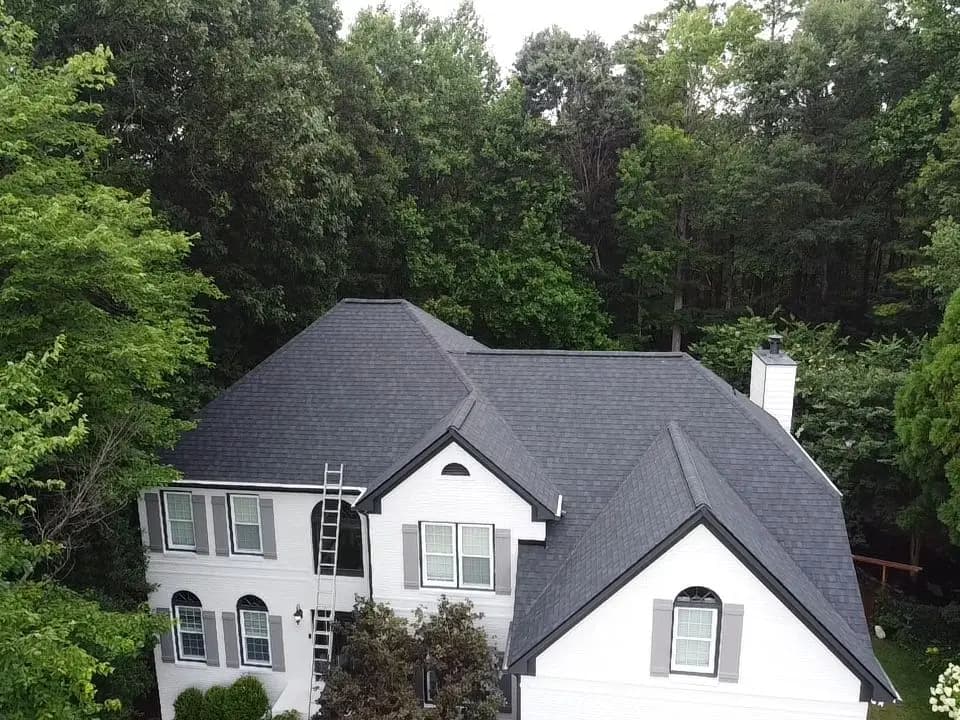
Drive any street in Canton, Woodstock, or Roswell and you will see it: houses tucked under pines and oaks that were there long before the subdivision was. That shade is a big part of why people want to live here. It also means that on a lot of the roofs my crews work on, the biggest long-term threat is not the weather. It is the tree next to the house.
Our crews handle repairs, replacements, and emergency calls across Cherokee, Cobb, and North Fulton counties, and I have stood on plenty of roofs that a limb has been sanding down for years, and on a few that a whole tree came through overnight. This article covers both ends of that: what overhanging limbs do to a roof day to day, how much room your roof really needs, and what to do, in order, if a tree ever lands on your house.
Why North Georgia Roofs Live With Trees
Our signature tree is the loblolly pine, and it gets big. University of Florida IFAS Extension lists its typical landscape height at 50 to 80 feet, and forest-grown trees go well past that. Add in mature white oaks, water oaks, and tulip poplars, and it is normal for a two-story house here to have several trees taller than the house within striking distance.
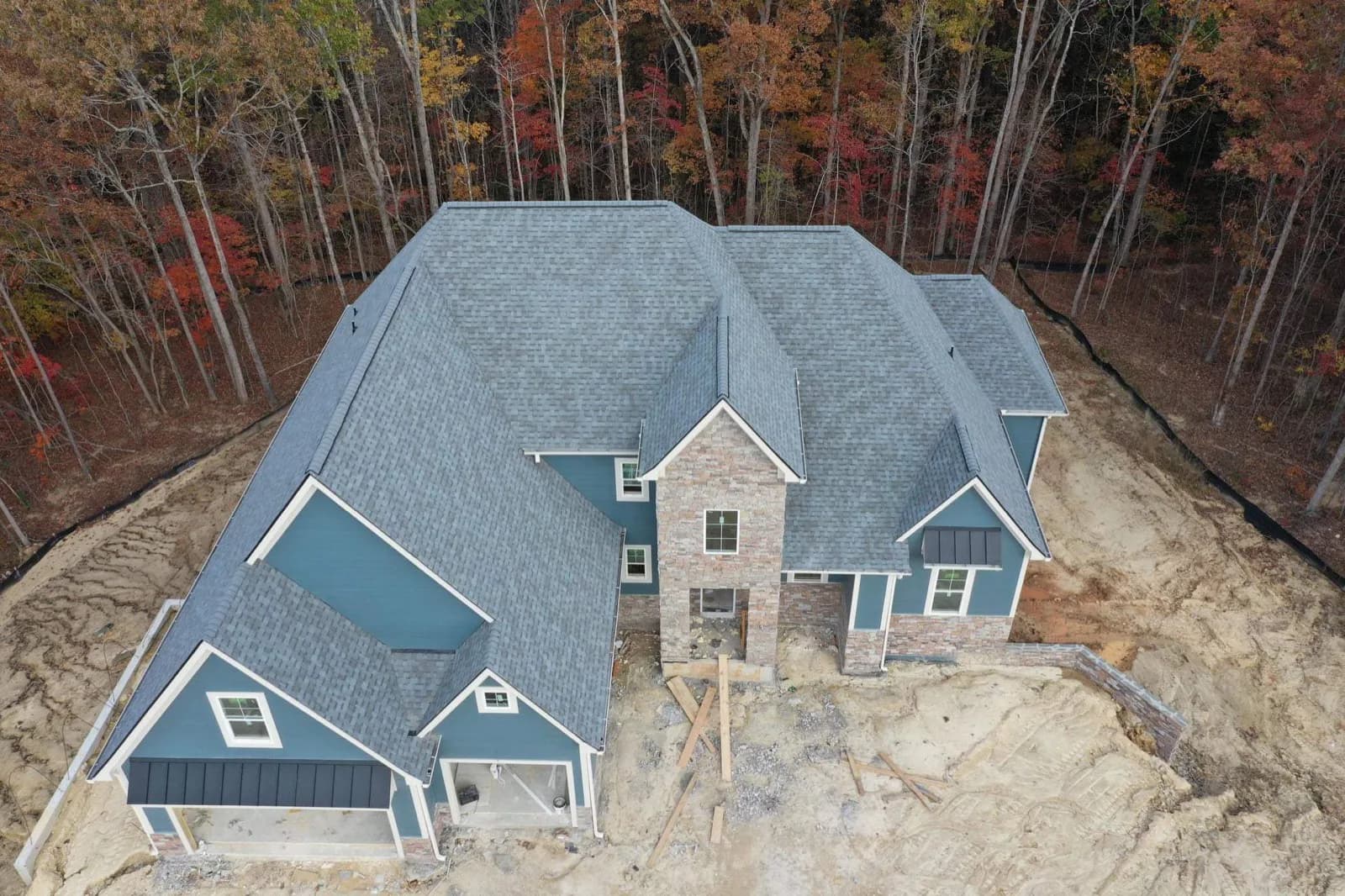
That is not a reason to cut them all down. Healthy, well-pruned trees shade the roof, cut cooling costs, and hold up fine through most storms. The goal is to keep the branches off the roof and catch the weak trees before a storm does. When we do a free roof inspection, the trees around the house are part of what we look at, because they tell us a lot about how the roof will age.
Four Ways Overhanging Limbs Wear Out a Roof
Most tree damage is not dramatic. It is slow, and it shows up years before anything falls.
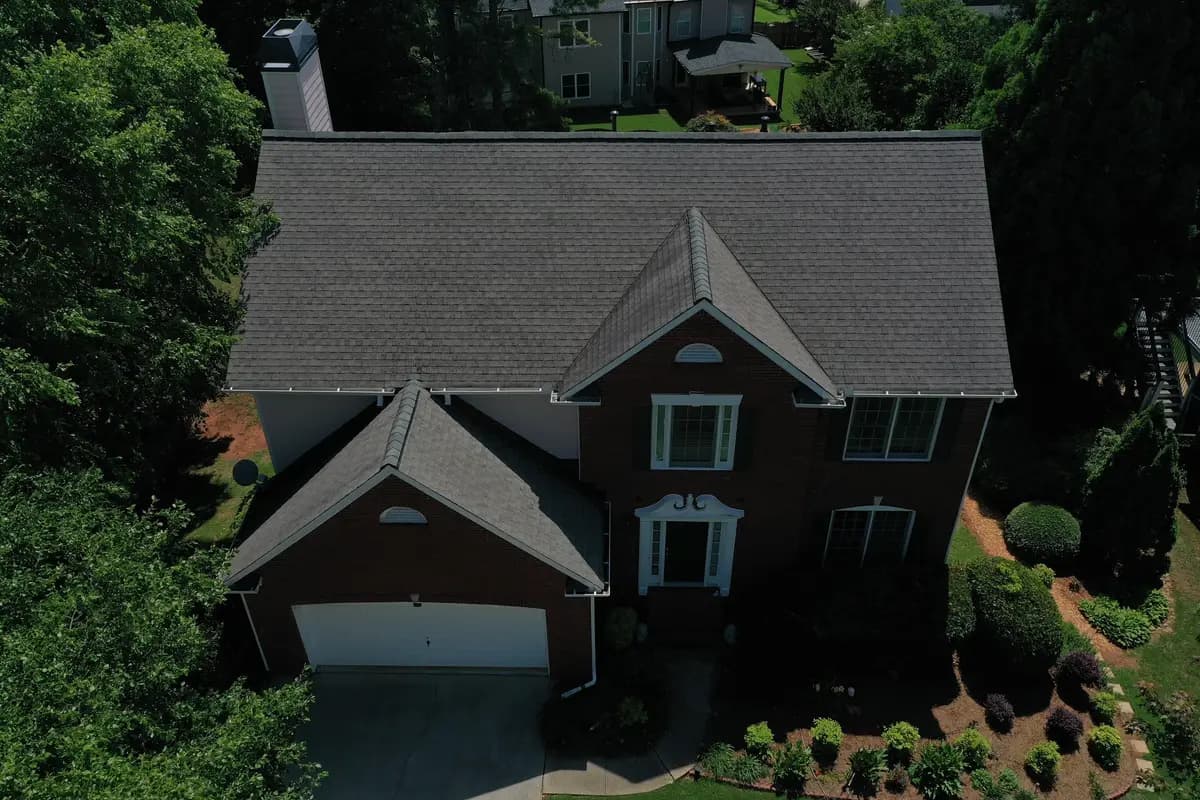
1. Abrasion. A branch resting on or near the roof moves every time the wind blows. That constant rubbing scrubs the protective granules off the shingles, and once the asphalt underneath is exposed to the sun, it dries out and cracks. We often find a bald, worn strip on an otherwise healthy roof, and it lines up exactly with a limb overhead.
2. Debris and clogged gutters. Pine needles, oak leaves, catkins, and twigs pile up in valleys and behind chimneys, and they pack the gutters. Water that cannot drain backs up under the roof edge and rots the decking and fascia. Our article on how gutters protect your roof explains why that matters so much here.
3. Shade and moisture. A roof that never gets direct sun stays damp after every rain. Damp, shaded shingles are where algae streaks and moss take hold, and moss holds water against the roof like a sponge. Our guide to how long a roof lasts in Georgia covers how much humidity and shade can take off a roof's life.
4. A highway for critters. Squirrels and raccoons use overhanging limbs as a bridge to the roof. Once they are up there, a soft spot at the fascia or a gap at a roof vent is an easy way into the attic. Trimming the limbs back takes away the bridge: Alabama Extension suggests at least 8 feet, about as far as a squirrel can jump, which our guide to keeping squirrels and raccoons out of the roof covers in detail.
And then there is the fifth way, the one everybody worries about: a dead limb or a whole tree coming down in a storm. That is where clearance and a good arborist come in.
How Much Clearance Your Roof Needs
There is no single legal standard for how far branches must be from a roof, so here is what we go by. GAF, the shingle manufacturer, recommends at least 6 feet between the roof and the tips of the branches. On fast-growing trees like our pines and water oaks, I like to see closer to 10 feet after a trim, because a 6-foot gap can close up in a couple of growing seasons.
A few rules of thumb that go with that diagram:
- Dead wood first. The International Society of Arboriculture (ISA) points to dead branches as the most obvious hazard in a tree. Cracks or splits in the trunk or a major limb, a tree that has started to lean, mushrooms or cavities near the base, and broken limbs hung up in the canopy are the other warning signs.
- Hire a certified arborist for anything big. ISA Certified Arborists have passed the ISA certification exam, and they know how to take weight off a tree without ruining it. A bad cut can weaken a tree and make the next storm more dangerous, not less. Ask any tree service for proof of insurance before they start.
- Leave power lines alone. If limbs are touching or close to the lines that feed your house, call Georgia Power (or your EMC) and let them handle it. The Electrical Safety Foundation International (ESFI) recommends staying at least 10 feet from overhead lines when working outside.
- Do not climb up there to do it yourself. A chainsaw on a ladder or a roof is how people get badly hurt. Trimming is the arborist's job. Fixing whatever the limbs did to the roof is ours.
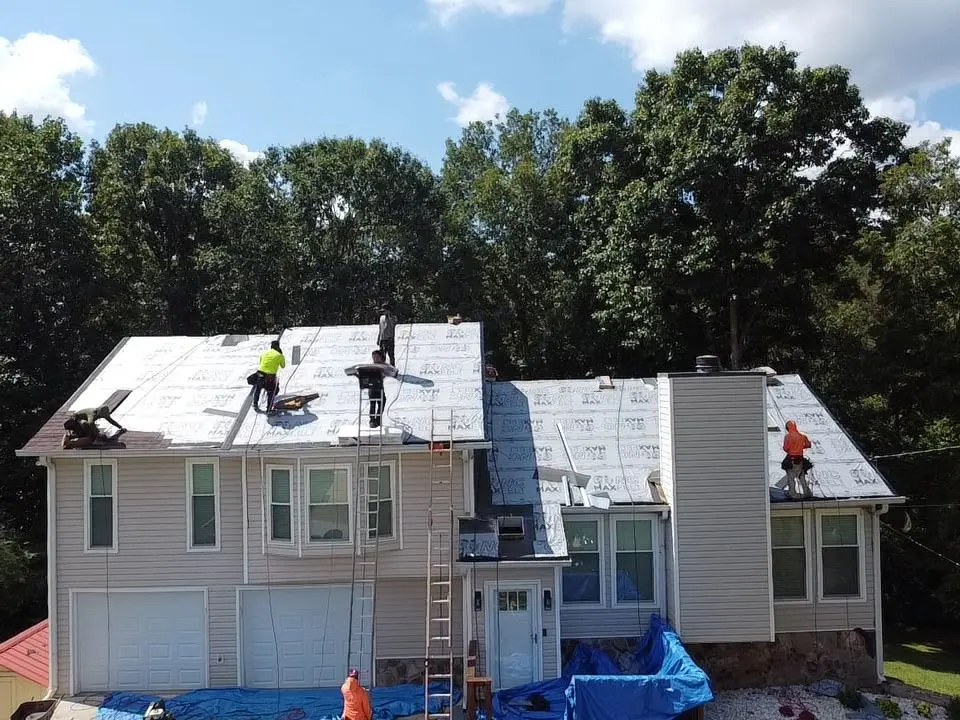
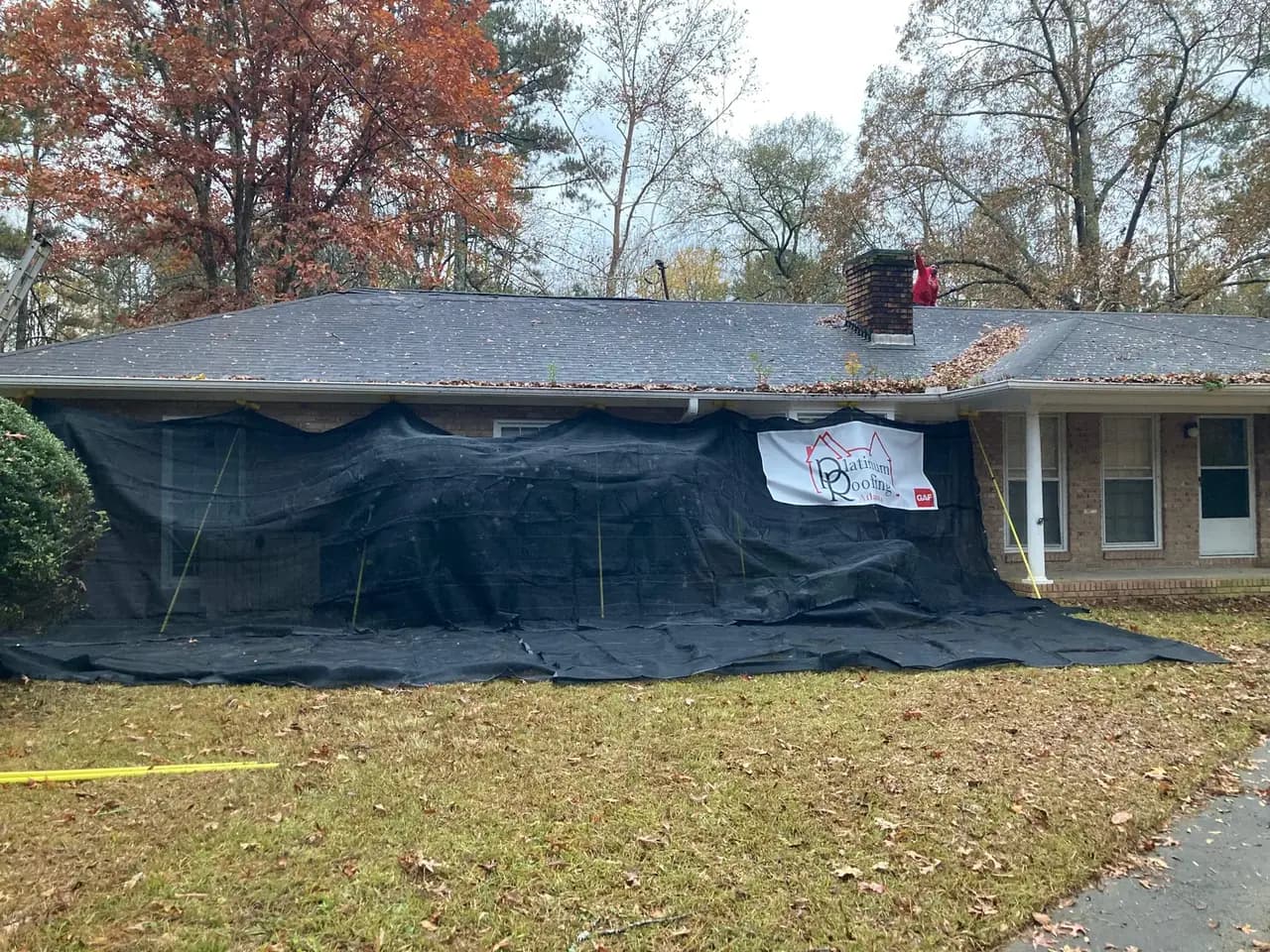
Photo: Platinum Roofing. Our crew replacing a roof on a Woodstock home with a stand of tall hardwoods right behind it. Homes like this one are why we look at the trees on every inspection.
If a Tree Falls on Your Roof: Safety First
Most of the time, a tree comes down during a storm, often at night, and the first few minutes are confusing. Here is the order that matters.
Get everyone out of the rooms under the damage. A ceiling holding up a tree, or holding water, can let go without warning. Close the door to that part of the house and stay out.
Look for power lines before you go outside. A tree that took down the lines to your house can leave a live wire in the yard, on the tree, or touching a fence. ESFI says to assume every downed line is live, to stay at least 35 feet away (about three car lengths) from the line and anything it touches, and to call 911. You can also report it to Georgia Power at 1-888-891-0938. Do not touch the tree if a line is anywhere near it.
If you smell gas or see sparks, get everyone out of the house and call 911 from a safe distance.
Do not climb on the roof, and do not try to cut the tree off it yourself. A tree lying on a roof is a loaded spring. Cutting the wrong piece can drop the rest of it through the ceiling or onto you. That part belongs to a professional tree crew with the right equipment.
Once everyone is safe, the clock that matters is water. Here is how the first two days usually go when one of these calls comes in to us.
Document Everything Before It Moves
Your photos are the backbone of the insurance claim, and the scene changes fast once the tree crew starts cutting. From a safe spot on the ground, take wide shots of the whole house and the tree on it, then closer shots of where it hit. Inside, photograph the ceilings, walls, floors, and anything that got wet. A short video walking through the house works well too.
Keep a note of the date and time, and keep every receipt: the tree service, the tarp, fans, a hotel if you had to leave. Most policies expect you to take reasonable steps to keep the damage from getting worse, and those receipts show that you did. Our article on what to do after a storm damages your roof goes through the claim steps in more detail.
Who Removes the Tree, and Who Fixes the Roof
This is the question we hear most, and it is simpler than it sounds. There are two separate jobs.
The tree crew removes the tree. Getting a heavy trunk off a roof takes rigging, sometimes a crane, and people trained to do it. We do not take down trees. Look for an insured tree service, ideally one with an ISA Certified Arborist on staff, and ask for proof of insurance before anyone climbs.
The roofer secures and repairs the roof. Once the weight is off, we tarp the opening so no more water gets in, then come back to inspect what the tree actually did. On a tree strike, the hole you see from the yard is rarely the whole story. Rafters can crack, decking can split well beyond the impact point, and gutters and fascia get torn. We photograph all of it for your adjuster. If framing is damaged, that gets repaired before any new roofing goes on.
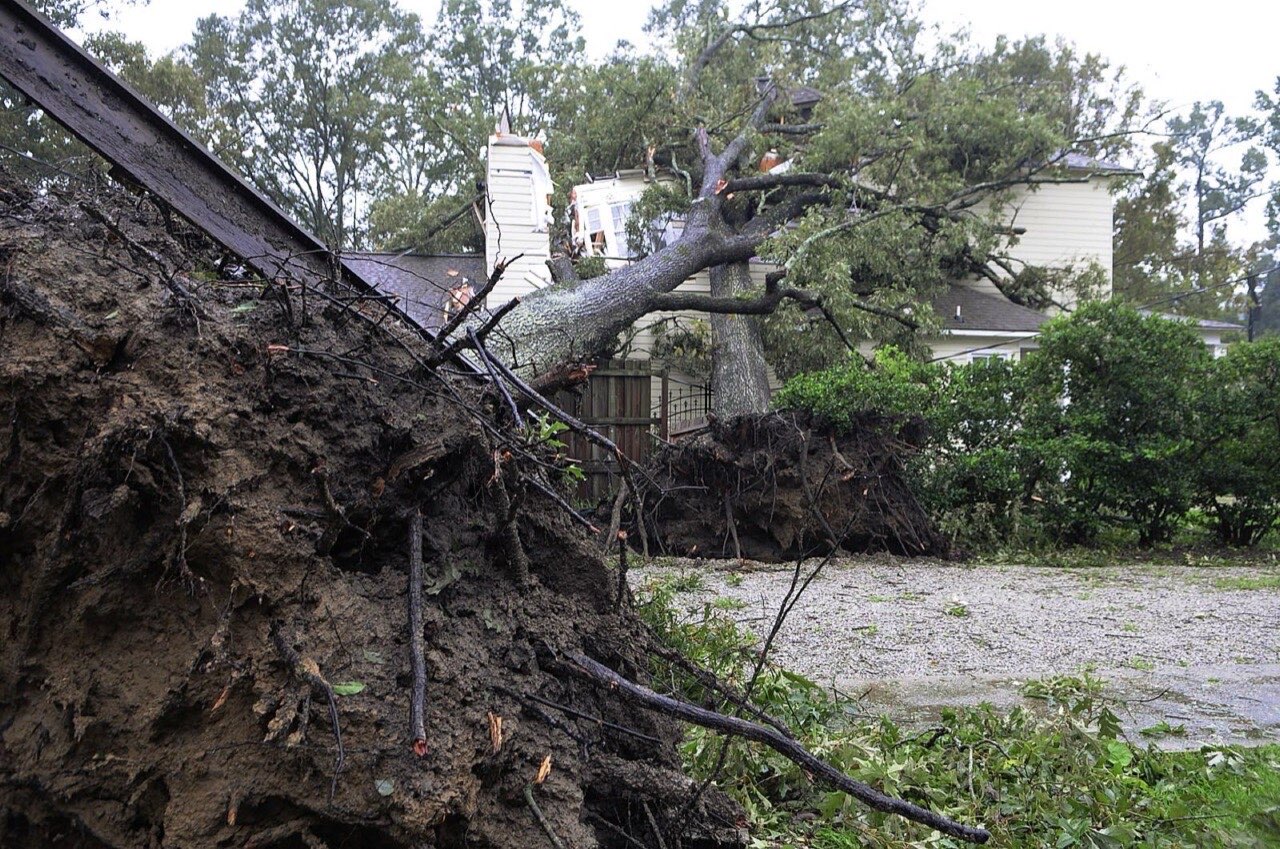
Photo: Barry Bahler, via Wikimedia Commons (Public domain). Shown to illustrate how wet ground and high wind can uproot mature trees and drop them onto a house.
Who pays. Under a typical Georgia homeowners policy, a tree that falls on your house in a storm is generally covered as storm damage, minus your deductible. According to the Insurance Information Institute, it does not matter whose yard the tree grew in: if it hits your house, the claim goes through your own insurer. The Institute also notes that removal of a tree that hits an insured structure is usually covered only up to a limit, often around $500 to $1,000 depending on the policy, and that a tree that falls without hitting a structure is usually your own cleanup. A tree that was obviously dead or rotting can complicate a claim, which is one more reason to deal with dead trees before a storm. Every policy is different, so read yours or call your agent. Our guide to whether homeowners insurance covers a roof replacement in Georgia explains deductibles and how claims are paid.
Repair or Replace After a Tree Strike?
A limb that punctured one area of a newer roof is usually a repair: we replace the damaged decking, rebuild the flashing and underlayment, and blend in matching shingles. A big impact on an older roof, or damage that crosses several slopes, can tip the decision toward a full replacement, especially if matching shingles is no longer possible. I walk through how we make that call in roof repair vs. replacement. Either way, we give you the photos and a straight answer, and we work with your adjuster so the claim reflects the real scope of the damage.
Get Ahead of It This Fall
The best tree call is the one that never becomes an emergency. Late fall and winter are a good time to look up: the hardwoods have dropped their leaves, so dead limbs and the shape of the canopy over the roof are easy to see. Have an arborist take care of the trees, and have us check what the limbs have already done to the shingles, valleys, and gutters.
If a tree or limb has already come down on your house, call our emergency roofing line at (770) 419-5714. We answer emergency calls around the clock and tarp the damage to stop the water. For anything that is not an emergency, like worn spots under old limbs or a gutter crushed by a branch, our roof repair team can help, and you can book a free roof inspection online. We serve Canton, Woodstock, Holly Springs, Roswell, Alpharetta, Marietta, Kennesaw, and the rest of our North Georgia service area.
Frequently Asked Questions
How far should tree branches be from my roof?
GAF, the shingle manufacturer, recommends at least 6 feet between the roof and the tips of the branches. On fast-growing trees like pines and water oaks, we suggest trimming back closer to 10 feet so the gap does not close up within a season or two. Have an ISA Certified Arborist do the trimming, and leave any limbs near power lines to the utility.
What should I do first if a tree falls on my house?
Get everyone out of the rooms under the damage and stay out of them. Before going outside, look for downed power lines: stay at least 35 feet away from any line and anything it is touching, and call 911. Then take photos, call your insurance company, and call a roofer to tarp the roof once a tree crew has the weight off.
Does homeowners insurance cover a tree falling on my roof?
When a tree falls on your house during a storm, a standard Georgia homeowners policy generally covers the damage, minus your deductible, even if the tree was in your neighbor's yard. Tree removal is usually covered only up to a set limit, often $500 to $1,000. A tree that falls without hitting a structure is usually not covered. Check your own policy, since coverage varies.
Who removes a tree that has fallen on my roof?
A professional tree service removes the tree, and a roofer secures and repairs the roof. Do not try to cut a tree off a roof yourself, because the weight can shift and drop through the ceiling. Choose an insured tree service, ideally one with an ISA Certified Arborist.
Can overhanging branches damage my roof even if they never fall?
Yes. Branches that rub the roof wear the granules off the shingles, falling debris clogs gutters and valleys, constant shade keeps the roof damp so algae and moss grow, and limbs give squirrels and raccoons an easy path to the attic. Trimming them back helps the roof last longer.
How fast can you tarp a roof after a tree falls?
We answer emergency calls 24/7 and can often get a tarp on the same day, once the tree is off the roof and the area is safe to work. Call (770) 419-5714 and tell us it is an emergency. In our humid climate, getting the roof covered and the inside dried within the first day or two is what keeps a tree strike from turning into a mold problem.

About the Author
David Blackwell
Production Manager at Platinum Roofing, running the crews and quality checks on roof and seamless gutter installations across Canton, Woodstock, and the greater North Atlanta metro. Meet the Platinum Roofing team →